
Visual Audio Splitter & Joiner
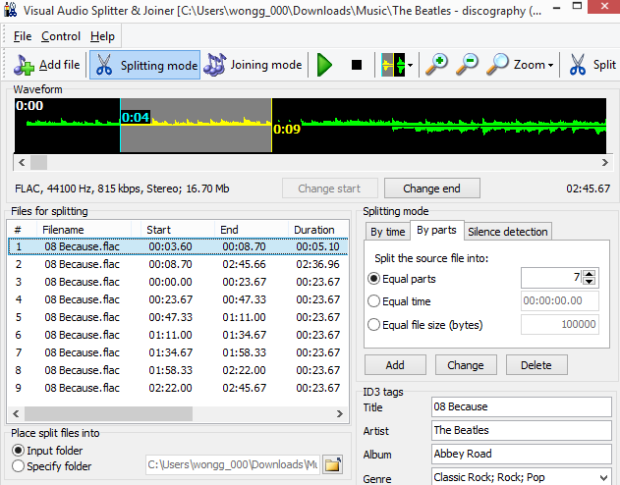
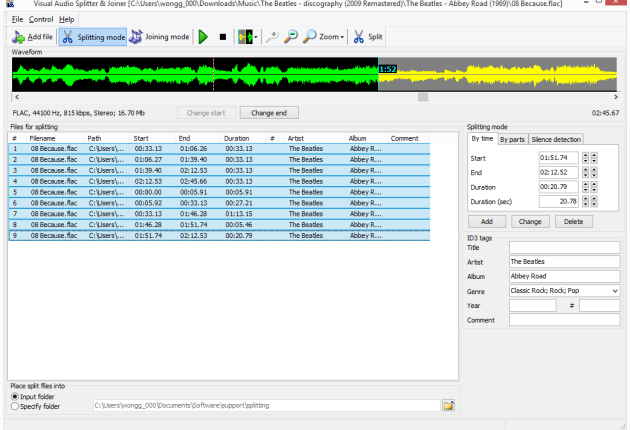
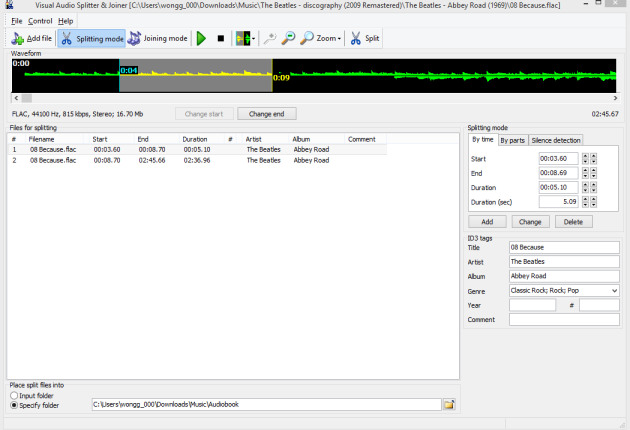
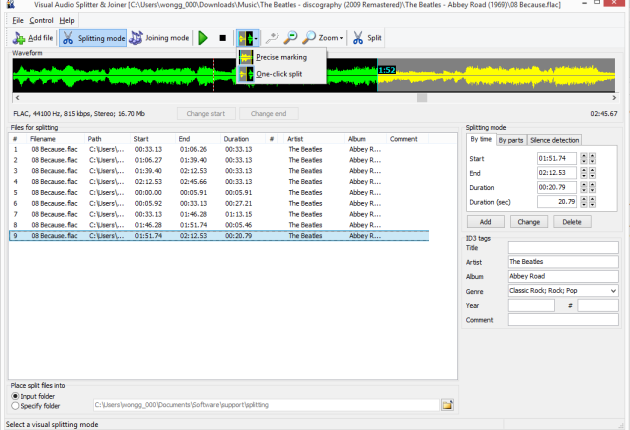
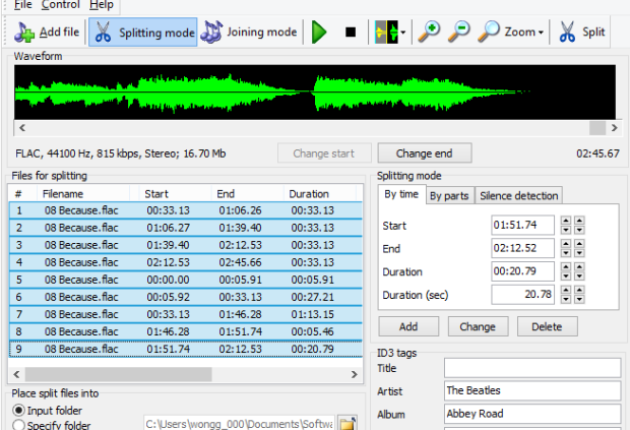
A handy software utility that can split and combine audio files. Cut files fast and easy using the waveform without losses in quality.


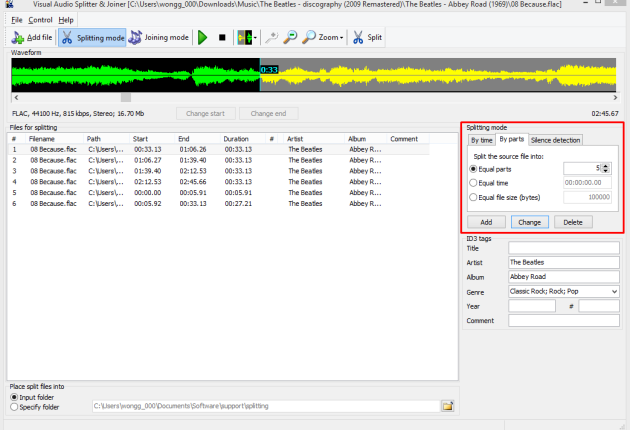
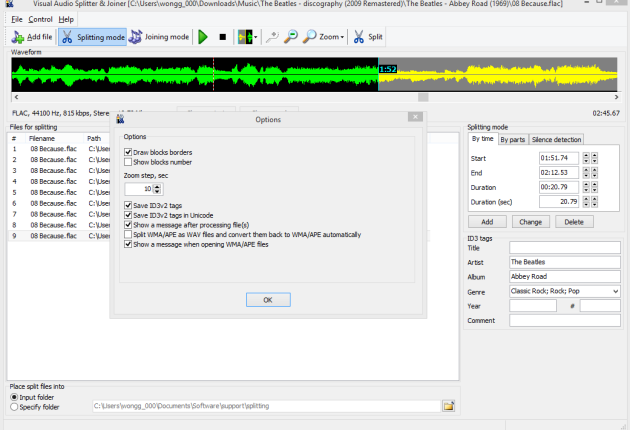
Split MP3, WMA, APE, and WAV files by a number of equal parts, by size, by duration. All the supported formats are split directly, without conversion!




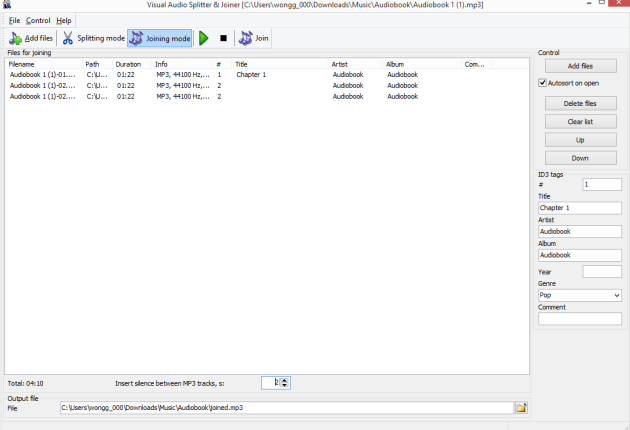
Visual Audio Splitter & Joiner allows you not only to split multiple audio files at once but also in any order. Join MP3, APE, WMA, and WAV files in any succession. Note that only parts in the same format can be merged. So if you want to merge files in different formats, you can convert them to the desired output format with AudioConverter Studio.

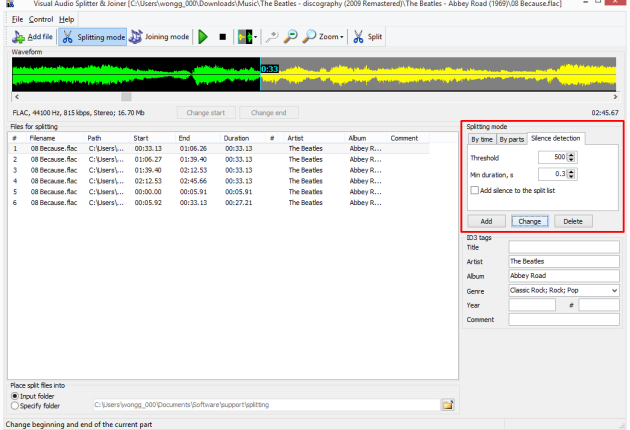
Suppose that you have an album of your favorite band in a single file and want to get easy access to each song. Visual Audio Splitter & Joiner is the right tool for this. In just a few seconds it will detect pauses between songs using the silence detection feature. All you need to do is to click the “Split” button. The MP3 splitter will deliver the result in virtually no time.

CUE files can be also used with media players. Nowadays many media players support CUE sheets either by using plugins or by initial design. CUE sheet is a simple text file (in ASCII encoding) which contains information concerning how audio tracks should be laid out on a CD.
Visual Audio Splitter & Joiner will help you create CUE sheets that will retain the detailed information. In this case, you don’t actually split the file but merely save the information about its parts into a CUE file.


Visual Audio Splitter & Joiner is so fast that you might ask: “Is it good for my files?”. The funny thing is, however, that Visual Audio Splitter & Joiner has absolutely no impact on quality.
The leap to 4K in streaming archives allows the viewer to read the environment as a character. In this episode, the Cooper household is not just a set; it is a cartography of loss. The 4K detail reveals the scuff marks on George Sr.’s work boots, the subtle fraying of Mary’s collar, and the dust motes dancing in the Texas sunlight that cuts through the blinds. This resolution forces us into an uncomfortable intimacy.
The A-plot involves Sheldon receiving a solar-powered calculator, a device of pure logic in an illogical world. While his twin sister Missy grapples with the social physics of a boy liking her (the "cheerleader’s bosom" of the title), and his brother Georgie discovers the transactional nature of capitalism, Sheldon retreats to binary truth.
In the annals of sitcom history, the multi-camera, laugh-track-driven format has rarely been a vehicle for subtlety. Yet, Young Sheldon , as a single-camera prequel to The Big Bang Theory , operates in a different register. Season 2, Episode 8—"A Solar Calculator, a Game Ball, and a Cheerleader’s Bosom"—is a masterclass in emotional compression. When viewed in 4K Ultra High Definition, the episode transcends its sitcom origins, becoming a study in the textures of grief, the violence of intellectual isolation, and the quiet geometry of a family falling apart. The 4K resolution does not merely sharpen the image; it sharpens the pain. young sheldon s02e08 4k
The title’s most provocative element—the cheerleader’s bosom—belongs to Missy’s subplot. In a lesser show, this would be a crude joke. In Young Sheldon , it is a rite of passage. Missy stares at a photograph of a cheerleader, not with lust, but with confusion. She is trying to understand the social algorithm that Sheldon cannot: Why do people like certain bodies? Why does attention flow in certain directions?
Sheldon closes the episode by calculating that the odds of his family staying together are "unfavorable." In 4K, we see him write that number down in his notebook. The ink bleeds into the paper fiber. That bleed is the episode’s final message: grief is not a bug in the system. Grief is the system. And no resolution—not 4K, not 1080p, not even the infinite resolution of a child’s memory—can make it go away. It can only make us see it more clearly. The leap to 4K in streaming archives allows
"A Solar Calculator, a Game Ball, and a Cheerleader’s Bosom" is not about a boy genius solving equations. It is about the discovery that some equations have no solution. The 4K presentation is not a luxury; it is a narrative necessity. It forces us to sit in the uncomfortable, pixel-perfect reality of the Coopers’ living room, to witness the cracks in the drywall and the cracks in their souls.
The 4K close-up of the calculator’s LCD screen flickering in the sun is the episode’s visual thesis. Sheldon attempts to calculate the probability of his father’s happiness, the vector of his parents’ marriage, and the thermodynamics of a family argument. The resolution allows us to see the reflection of Sheldon’s terrified face in the blank screen before the numbers appear. This is the tragedy of the high-IQ child: he believes that if he can just find the right equation, he can solve human pain. The 4K detail exposes the futility—the calculator’s plastic casing is cheap, its buttons stiff. It is a toy. Sheldon’s weapon against chaos is a toy. This resolution forces us into an uncomfortable intimacy
The Fractal Geometry of Grief: Deconstructing “A Solar Calculator, a Game Ball, and a Cheerleader’s Bosom” in 4K