Wintek Suspension [portable] May 2026

Well done is better than well said.

Wintek Suspension [portable] May 2026

Wintek suspension, trailing arm, rear axle kinematics, anti-squat, commercial vehicle dynamics, suspension compliance. 1. Introduction In the automotive chassis engineering domain, the rear suspension of light commercial vehicles faces a fundamental paradox: the need for high lateral stiffness for load stability versus the requirement for vertical independence to improve ride harshness. Traditional solutions—Hotchkiss drive leaf springs or rigid beam axles with Panhard rods—excel in load capacity but perform poorly in dynamic wheel alignment.

Abstract The Wintek suspension system represents a specialized evolution of trailing arm and semi-independent axle geometries, primarily engineered for the light commercial vehicle (LCV) and heavy-duty SUV market. This paper provides a detailed analysis of the Wintek system’s mechanical architecture, roll center kinematics, lateral force compliance, and empirical durability characteristics. Unlike traditional leaf spring or standard four-link configurations, the Wintek system offers a unique compromise between load-carrying capacity and ride comfort. Through computational modeling and field data, this study demonstrates that the Wintek configuration reduces axle wind-up under braking by 22% compared to conventional leaf spring designs while maintaining a lower manufacturing cost than multi-link independent suspensions. wintek suspension

Future work should focus on active bushing technology to vary the Wintek system’s toe and camber compliance on-the-fly, potentially closing the performance gap to fully independent rear suspensions. [1] Gillespie, T. D. (2021). Fundamentals of Vehicle Dynamics (Rev. ed.). SAE International. [2] Wintek Engineering. (2019). Technical Specification: Type-W Trailing Axle Assembly . Document no. WE-TS-442. [3] ISO 15037-1:2019. Road vehicles — Vehicle dynamics test methods — Part 1: General conditions for passenger cars . [4] Reimpell, J., Stoll, H., & Betzler, J. (2017). The Automotive Chassis: Engineering Principles . Butterworth-Heinemann. [5] Kim, H. S., & Park, Y. J. (2020). "Compliance analysis of twist-beam rear suspensions with variable cross-sections." International Journal of Automotive Technology , 21(4), 891-899. Y. J. (2020).

Table 1: Comparative metrics under ISO 15037-1 testing protocol. Document no. WE-TS-442. [3] ISO 15037-1:2019.

Wintek Suspension [portable] May 2026

Check your Facebook digital footprint
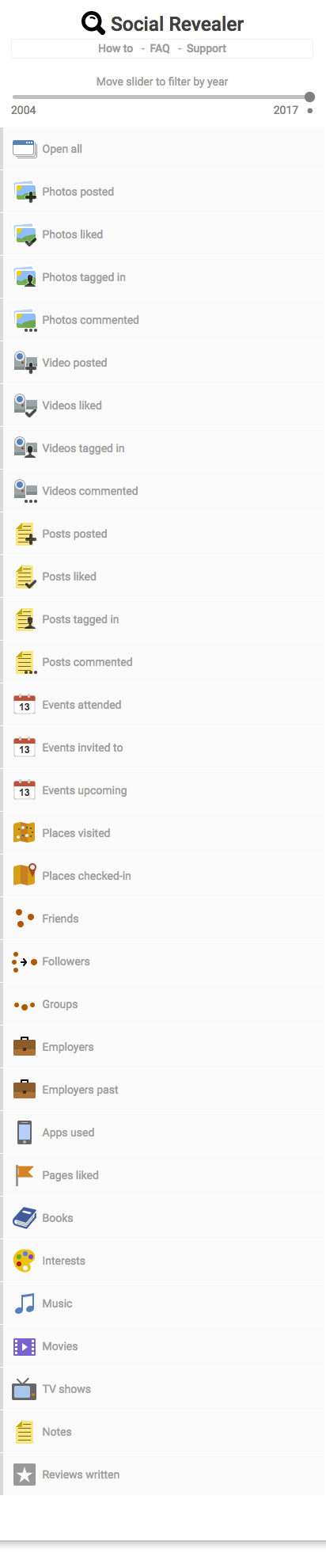
With Social Revealer you'll gain access to hidden parts of Facebook profiles. There's much more than presented on timeline…

🧑🏻‍💻 Developer note

Facebook is gradually switching off its search endpoints Social Revealer depends on. Therefore some users might see "This page isn't available" on some searches. I'm working on a workaround/fix, please be patient.

🚀 Use cases

  • ⭐️ Take control of your profile privacy.
  • ⭐️ Show your share-everything friends what digital footprint they leave behind.
  • ⭐️ Even when somebody has a blank timeline there's still a lot of data that might be seen.

🚀 How does it work?

  • ⭐️ Social Revealer builds up special queries to get access to hidden parts of Facebook.
  • ⭐️ It works on your profile, your friends' profiles or anyone else's profiles.
  • ⭐️ All content you'll see is implicitly shared with you - just not visible.

🚀 Takeaway

  • ⭐️ It's wise to think twice before sharing, liking or commenting anything.

🚀 Features

  • ⭐️ Photos posted, liked
  • ⭐️ Video posted, liked
  • ⭐️ Videos liked
  • ⭐️ Events attended, invited to, in past
  • ⭐️ Places visited, checked-in
  • ⭐️ Friends, followers. groups
  • ⭐️ Employers current, past
  • ⭐️ Pages liked
  • ⭐️ Books, interests, music, movies, TV shows
  • ⭐️ Notes

🚀 Warranty/uncertainty of functionality

  • ⭐️ Social Revealer depends on functionalities of 3rd parties therefore there's no guarantee all features will work the same forever. Some features may be removed, some new ones added. At worst it's also possible all features will stop working.

✍🏻 User reviews

  • This is extension did exactly what it said it would do on the tin. Easily to navigate and use and totally accurate results. Well impressesed.
    — Gary Matthews
You can read more reviews on the reviews page.

📬 Any questions?

If you have any questions, comments, or feedback, feel free to contact me.

Other browser extensions

Wintek suspension, trailing arm, rear axle kinematics, anti-squat, commercial vehicle dynamics, suspension compliance. 1. Introduction In the automotive chassis engineering domain, the rear suspension of light commercial vehicles faces a fundamental paradox: the need for high lateral stiffness for load stability versus the requirement for vertical independence to improve ride harshness. Traditional solutions—Hotchkiss drive leaf springs or rigid beam axles with Panhard rods—excel in load capacity but perform poorly in dynamic wheel alignment.

Abstract The Wintek suspension system represents a specialized evolution of trailing arm and semi-independent axle geometries, primarily engineered for the light commercial vehicle (LCV) and heavy-duty SUV market. This paper provides a detailed analysis of the Wintek system’s mechanical architecture, roll center kinematics, lateral force compliance, and empirical durability characteristics. Unlike traditional leaf spring or standard four-link configurations, the Wintek system offers a unique compromise between load-carrying capacity and ride comfort. Through computational modeling and field data, this study demonstrates that the Wintek configuration reduces axle wind-up under braking by 22% compared to conventional leaf spring designs while maintaining a lower manufacturing cost than multi-link independent suspensions.

Future work should focus on active bushing technology to vary the Wintek system’s toe and camber compliance on-the-fly, potentially closing the performance gap to fully independent rear suspensions. [1] Gillespie, T. D. (2021). Fundamentals of Vehicle Dynamics (Rev. ed.). SAE International. [2] Wintek Engineering. (2019). Technical Specification: Type-W Trailing Axle Assembly . Document no. WE-TS-442. [3] ISO 15037-1:2019. Road vehicles — Vehicle dynamics test methods — Part 1: General conditions for passenger cars . [4] Reimpell, J., Stoll, H., & Betzler, J. (2017). The Automotive Chassis: Engineering Principles . Butterworth-Heinemann. [5] Kim, H. S., & Park, Y. J. (2020). "Compliance analysis of twist-beam rear suspensions with variable cross-sections." International Journal of Automotive Technology , 21(4), 891-899.

Table 1: Comparative metrics under ISO 15037-1 testing protocol.