HD Videos always in sync
Video players never go out of sync with our cutting edge technology, even across different episode. So binge watch party TV shows in single watch party.

Start playing video on Netflix or other supported platforms.
Once video starts playing, click the Flickcall logo visible on top right to start watch-party (visible for 10 sec). You can also start party from Flickcall icon on chrome toolbar.
Click start party and copy invite link. Send the invite link to anyone to join your watch party.










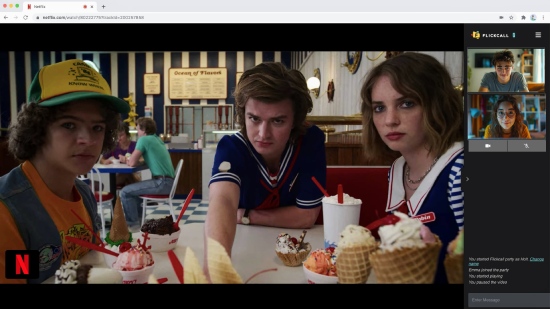
Create watch parties on Netflix, Disney+, JioHotstar, JioHotstar, HBO Max, MAX, Hulu, Prime Video, Youtube, Zee5, Sony Liv, JioHotstar with Flickcall.

Video players never go out of sync with our cutting edge technology, even across different episode. So binge watch party TV shows in single watch party.

Watch your friends laughing with you, Emotions shared in real-time. This is the next best thing after being together.

After installing extension, play the video and click Flickcall logo at top right to start party. Easy-peasy!!
Mic is muted automatically during video play and activated whenever video is paused to engage in seamless conversations. So hit pause and start speaking.

Our peer to peer technology delivers your personal chats and calls directly to your friends instead of the traditional approach of routing it via servers.


* In some cases, firewall setting doesn't allow direct connection, the calls and messages are encrypted and routed via our servers.
In conclusion, asking “what are the seasons in Brazil?” has no single answer. The country offers a masterclass in climatic diversity. From the inverted summer-winter cycle of the Southern Hemisphere to the binary wet-dry rhythm of the Amazon and the true four seasons of the South, Brazil defies simplistic categorization. For the majority of Brazilians, the year is marked not by the first snowfall or the autumn leaf, but by the first heavy rain of the summer, the crisp, dry air of the “winter,” and the relentless, even heat of the equatorial zone. To understand Brazil’s seasons is to understand that nature’s calendar is not universal, but wonderfully local and diverse.
The most fundamental fact about Brazilian seasons is their inversion compared to the Northern Hemisphere. Because Brazil lies mostly south of the equator, its summer runs from December to March, and its winter occurs from June to September. This means that while New York or London shovels snow in January, Rio de Janeiro and São Paulo experience the height of summer, with long, hot days, New Year’s Eve beach parties, and the world-famous Carnival in February or early March. Conversely, July is the heart of the Brazilian winter, a time when southern cities like Porto Alegre and Curitiba experience chilly temperatures, fog, and occasional frost. This inverted calendar is the first key to understanding that a Brazilian “winter” is not the same as a Canadian or Russian one.
A final, crucial season in Brazil does not appear on any calendar: the “season of the rains” in the semi-arid Northeast. The Sertão, or backlands, of states like Bahia and Pernambuco experiences a unique, unpredictable cycle of drought and short, intense rainy seasons. For the people living there, life is not organized around summer or winter but around the hope and arrival of the inverno (winter), which brings the few months of rain needed for crops and livestock. When the rains fail, the “dry season” can become a devastating multi-year drought. This demonstrates that in Brazil, the most meaningful seasonal division is often not temperature, but the life-giving or withholding presence of water.
When most people picture the seasons, they imagine the familiar cycle of spring, summer, autumn, and winter, often associated with temperate regions like North America or Europe. However, the concept of seasons changes dramatically depending on where you are on the globe. In Brazil, a vast country straddling the equator, the seasons exist but in a way that defies many common assumptions. Unlike the snow-filled winters and colorful autumns of the Northern Hemisphere, Brazil’s seasons are defined less by dramatic temperature shifts and more by a binary rhythm: the wet season and the dry season. Understanding the seasons in Brazil requires looking beyond the traditional four-part calendar and examining the country's immense size, its position in the Southern Hemisphere, and its dominant climate zones.