|
|
|
|
|
|
|
|
|
|
|
|
|
|
 |
|
||||||||||||
|
|
|
|
|
|
|
|
|
|
|
|
|
|
|
|
|
||||||||||||
| DragSim5 Vehicle-Dynamics 1/4- or 1/8-Mile Drag-Strip Simulation Includes ProTools™ Enhancements | ||||
|
DragSim5™
with ProTools™ is an
amazingly accurate 1/4- and 1/8-mile vehicle-dynamics
simulation for
Windows Vista, 7, 8, and 10 (32- and 64-bit) from the
experts at Motion Software, Inc. The simulation lets you to design and build any car, motorcycle or dragster
and accurately evaluate its performance at simulated dragstrip! Enter
any engine power curve, or test engines you've designed in DynoSim or Dynomation (you
can even test a variety of jet and rocket power plants!).
Test any manual or automatic transmissions, any gear ratios, any vehicle
weight, wheelbase, driving style, weather and traction conditions and more! Change
components with just a mouse click—drag-race times are instantly
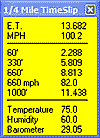
updated. A PopUp TimeSlip™ provides an easy-to-read visual summary of
overall vehicle performance. Even
test and compare multiple vehicles at once! Software Overview: DragSim5 simulates virtually any Automobile, Dragster, or Motorcycle using front- or rear-wheel drive! The simulation performs a comprehensive analysis of the physics that act on the vehicle as it accelerates from a standing start to terminal velocity over the 1/8- or 1/4-mile. This iterative (repeating, step-by-step) analysis determines vehicle performance for each fraction of an inch throughout the entire race. The results display looks similar to a professional data-acquisition system! You'll clearly see exact elapsed times, speeds, rpms, beginning at rollout to 60 feet, 330 feet, 660 feet (1/8-mile), 1000 feet, and 1320 feet (1/4-mile). ETs and speeds can be compared with up to four other vehicles to help locate the best component combinations. User Interface And
Features: DragSim5 has a completely
unique user interface built from the
ground-up to be clear and easy use. You'll find vehicle component parts and
specifications on the left side of the screen, and simulation results on the
right! Eye-popping graphics are Even though this program is sophisticated, DragSim5 was carefully designed to be easy to use. For example, a Pop-Up TimeSlip™ provides an instant summary of the performance potential of any vehicle. A quick glance will help you make judgments about gear ratios, shift points, vehicle weight, and it can even help you evaluate traction and wheelspin!. Similar to the paper time slip delivered to racers at the end of a run, the DragSim5 Pop-Up TimeSlip™ is a helpful, at-a-glance analysis of track results.
ProTools™: Professionals need all the modeling power they can get. The ProTools™ included in DragSim5 extend the functionality of many program features. For example, the ProIterator™ lets you perform fully custom testing, DataZones™ give you the most graphing and data analysis power possible, ProData™ includes a new table of extended vehicle performance data, and ProPrinting™ prints out a comprehensive test report that can include your name, address, custom logo, glossaries, and all ProData™ values. If you're serious about drag racing, the DynoSim5 with ProTools™ was made for you! Technical (under the
hood):
DragSim5 simulates the complex physics involved in 1/8- and
1/4-mile drag racing, including the incredible range of forces that act on
automobiles, dragsters, or motorcycles at the starting Users Manual: The DragSim5 is supplied with a full-color on-disk Users Manual (directly accessible from within the program) that details the features of this comprehensive simulation. If you wish, you can download a copy of this manual to preview the capabilities of this software before you buy (link provided at top of this page). Requirements: DragSim5 runs on any Windows 7, 8 10 or 11 equipped PC. A video display of 1024 x 768 resolution or greater is recommended. A Windows-compatible printer is required for test reports. Availability: The DragSim5 is available NOW!. See our Order Page for purchase information and Discount pricing. What You Can Do With The DragSim:
Tune These Key Vehicle Components:
What The Pros Say About The DragSim:
|
Compare Our Drag
Simulation
FREE—Download
Special Web Pricing What's New This Version:
Features:
Requirements:
|
|||
|
|
|
|
|
|
|
|
|
|
|
|
|
|
In the heart of Indianapolis, where the rhythms of Midwestern life pulse through bustling streets and quiet neighborhoods alike, there exists a concept as tangible as the bricks of its historic buildings: the door of hope. While not a single physical structure, “Hope’s Doors Indianapolis” represents a constellation of shelters, community centers, rehabilitation clinics, and faith-based outreach programs that serve as entryways from despair to dignity. These doors are more than mere entrances; they are thresholds where the city’s most vulnerable—the homeless, the addicted, the newly released, and the simply lost—find not just refuge, but a path forward.
Yet, hope’s doors in Indianapolis are not limited to social service agencies. They are also found in the second-chance hiring initiatives of local businesses on Massachusetts Avenue, in the free legal aid clinics of the Indiana Legal Services, and in the art therapy rooms of the Ascent 121 program for survivors of human trafficking. Consider the door of a small coffee shop near Fountain Square that proudly displays a “Fair Chance Employer” sticker. For a formerly incarcerated individual, that door represents a future beyond a criminal record. It is the quiet revolution of a manager who sees potential instead of a past. In a city with deep racial and economic disparities, such doors are acts of structural grace. hope’s doors indianapolis
The most visible of these doors is the Wheeler Mission’s Center for Women and Children. Located near the city’s core, its unassuming façade belies the profound transformations occurring within. For a mother fleeing domestic violence with only her child and the clothes on her back, that door is a lifeline. It is not merely a shelter from the brutal Indiana winter but an entry into a world of case management, job training, and long-term recovery. To walk through this door is to trade the paralysis of fear for the agency of action. It represents the first, hardest step: the decision to believe that safety and stability are still possible. In the heart of Indianapolis, where the rhythms
Of course, the doors are not always easy to find. Systemic barriers—lack of affordable housing, the opioid epidemic’s unyielding grip, and the invisible scars of trauma—can make the simplest door feel like a vault. This is why “Hope’s Doors” is not a single agency but an ecosystem. It requires the key of public funding, the hinges of volunteer hours, and the frame of a compassionate community. Yet, hope’s doors in Indianapolis are not limited
In the end, to speak of hope’s doors in Indianapolis is to speak of the city’s own character. It is a place that understands that progress is measured not by how it treats its successful citizens, but by how it opens doors for those who have fallen. Every time a family is housed, an addict finds sobriety, or a parolee finds a paycheck, a door that once seemed eternally closed reveals itself to have always been ajar. And on the other side is not a fairy-tale ending, but something far more real: the quiet, persistent light of a new beginning.
Indianapolis, known for the roar of the Indianapolis 500 and the grace of its war memorials, also holds a quieter legacy: a Midwestern pragmatism that believes in repair. The city’s approach to homelessness and addiction, through initiatives like the Mobile Crisis Assistance Team, reflects a philosophy that every person deserves a door to try again. These initiatives recognize that a locked door is a verdict; an open door is a conversation.
Perhaps the most poignant doors, however, are the ones that open from the inside out. Hope, after all, is not a passive state but an active verb. At the John H. Boner Community Center on the near-east side, a door marked “Career Crossroads” leads to a classroom where adults who have been left behind by the digital economy learn coding and soft skills. When they walk back out that same door into the Indianapolis sunlight, they are different people. They carry resumes, confidence, and a network. They have moved from the periphery of the economy to a position of contribution. Hope, in this sense, is not a handout but a hand finding the doorknob.

 performance or
racing application, automatically! DragSim5 is the most powerful and
easy-to-use straight-line vehicle-dynamics simulation available! And it’s
fun to use, too!
performance or
racing application, automatically! DragSim5 is the most powerful and
easy-to-use straight-line vehicle-dynamics simulation available! And it’s
fun to use, too!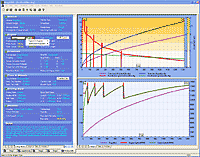 enhanced with
QuickAccess™ buttons and
DirectClick™
menus that let you change parts simply by clicking on any component. Analyze engine
RPM, Clutch RPM, Torque Converter Stall Speed, Acceleration, Tire Slip, Distance, ET, Aero Drag, and much more
(detailed below). All data and graphs can be
printed (and previewed) in color.
enhanced with
QuickAccess™ buttons and
DirectClick™
menus that let you change parts simply by clicking on any component. Analyze engine
RPM, Clutch RPM, Torque Converter Stall Speed, Acceleration, Tire Slip, Distance, ET, Aero Drag, and much more
(detailed below). All data and graphs can be
printed (and previewed) in color.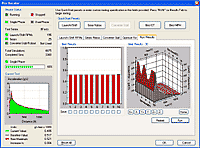 DragSim5 also incorporates
(Motion-exclusive) technology that helps you find
optimum combinations for any vehicle. To
start off,
the simulation includes a
Traction Calculator™ that optimizes tire/track modeling and
improves accuracy. A simple button click begins a comprehensive series of
hundreds of thousands of calculations to determine the tire/track adhesion
model that best simulates read-world conditions. You'll also be amazed by
Iterator™ testing built into DragSim5 that lets you "home in" on the best parts combinations, automatically!
Click one button and DragSim will perform hundreds,
or thousands of
drag tests! The Iterator™ keeps
track of all the results, and displays the best gear ratios and other parts combinations for you to review.
You'll locate the setup that delivers the quickest ET or the fastest MPH for any
street or racing application!
DragSim5 also incorporates
(Motion-exclusive) technology that helps you find
optimum combinations for any vehicle. To
start off,
the simulation includes a
Traction Calculator™ that optimizes tire/track modeling and
improves accuracy. A simple button click begins a comprehensive series of
hundreds of thousands of calculations to determine the tire/track adhesion
model that best simulates read-world conditions. You'll also be amazed by
Iterator™ testing built into DragSim5 that lets you "home in" on the best parts combinations, automatically!
Click one button and DragSim will perform hundreds,
or thousands of
drag tests! The Iterator™ keeps
track of all the results, and displays the best gear ratios and other parts combinations for you to review.
You'll locate the setup that delivers the quickest ET or the fastest MPH for any
street or racing application!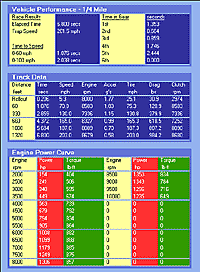 line. But you can leave your physics books on the shelf, because the
DragSim5 makes complex vehicle analysis as easy as 1, 2, 3. Pop-up menus allow you to enter any
engine power curve (also import DynoSim6 and Dynomation6 and other engine files). You can even test jet
or rocket power plants! Then choose vehicle components from simple drop-down
menus or enter custom specs for automatic or manual transmissions, torque
converter stall-speed, launch rpm, shift rpms, up to six transmission gears
with virtually any gear ratios, rear-axle ratios, vehicle weight, wheelbase,
front- or rear-wheel drive, frontal area, aero drag, tire width, rollout
distance, ambient temperature, humidity, wind speed, and more! Internal
"watchdogs" eliminate conflicting choices (like an rpm redline rpm set lower
than a shift rpm, etc.), ensuring accurate performance predictions.
line. But you can leave your physics books on the shelf, because the
DragSim5 makes complex vehicle analysis as easy as 1, 2, 3. Pop-up menus allow you to enter any
engine power curve (also import DynoSim6 and Dynomation6 and other engine files). You can even test jet
or rocket power plants! Then choose vehicle components from simple drop-down
menus or enter custom specs for automatic or manual transmissions, torque
converter stall-speed, launch rpm, shift rpms, up to six transmission gears
with virtually any gear ratios, rear-axle ratios, vehicle weight, wheelbase,
front- or rear-wheel drive, frontal area, aero drag, tire width, rollout
distance, ambient temperature, humidity, wind speed, and more! Internal
"watchdogs" eliminate conflicting choices (like an rpm redline rpm set lower
than a shift rpm, etc.), ensuring accurate performance predictions.