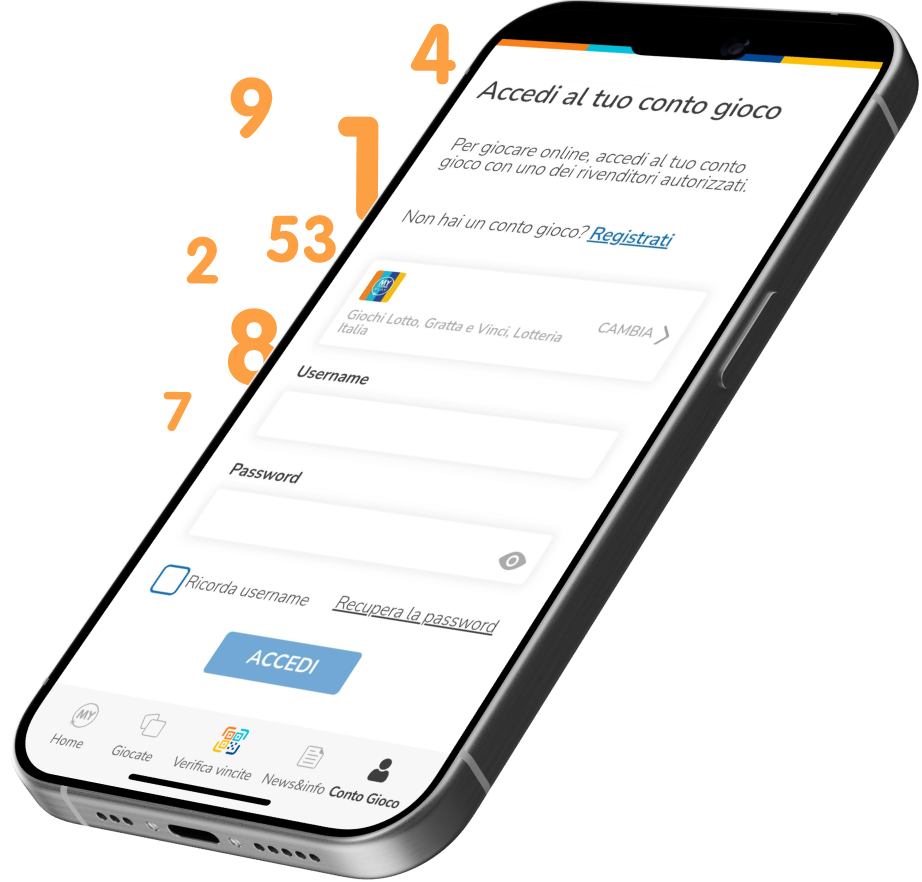
Con l’app ufficiale Lotto e Gratta e Vinci puoi verificare le
vincite, seguire le estrazioni in diretta e giocare on line
Scarica subito la nuova app!
Scarica subito la nuova app!
Inquadra il QR code oppure visita dal tuo smartphone il
sito
mylotteries.it
Inquadra il QR code con il tuo smartphone per aprire il sito
da mobile.
Inquadra il QR code con il tuo smartphone per aprire il sito
da mobile.
Come installare l'app
Come installare l'app
1Visita il sito
mylotteries.it
dal cellulare e premi il pulsante
SCARICA PER ANDROID
2Ti verrà chiesto di scaricare il file
MyLotteries.apk
premi il pulsante
SCARICA*
3Una volta scaricato il file premi il pulsante
APRI e infine
INSTALLA
*Se non hai mai scaricato un'app al di fuori del Play
Store vai su
IMPOSTAZIONI > SICUREZZA
del tuo smartphone e controlla che la voce
"Sorgenti sconosciute"
sia
ATTIVA
La tua esperienza di gioco in mobilità e in tutta sicurezza.
Con App My Lotteries puoi vivere la tua esperienza a
Lotto,
10eLotto,
MillionDay e
Gratta e Vinci
direttamente dal tuo smartphone dove e quando vuoi. Puoi
verificare se la tua giocata è vincente, compilare comodamente
la tua schedina in app e giocarla nel punto vendita, consultare
in qualsiasi momento gli ultimi numeri estratti nella sezione
archivio delle estrazioni e giocare online.
Con l’App My Lotteries puoi controllare se hai vinto semplicemente
inquadrando il biglietto Gratta e Vinci e lo scontrino del 10eLotto,
Lotto e MillionDAY nella sezione Verifica Vincite.
Battlefield 4 Offline Bots Extra Quality May 2026
To understand the frustration, one must first acknowledge what Battlefield 4 offers in lieu of bots. The game includes a single-player campaign, a brief, forgettable string of linear set-pieces about a "phantom" soldier and a Chinese admiral. However, this campaign is a poor substitute for the sandbox experience that defines the franchise. What players truly wanted was access to the multiplayer maps—the sprawling skyscrapers of Siege of Shanghai , the tropical chaos of Paracel Storm , the claustrophobic corridors of Operation Locker —populated by AI. In previous Battlefield titles, this mode was called "Conquest" against bots. It allowed a player to learn the flight mechanics of a helicopter without being shot down by a jet ace in 30 seconds, or to experiment with the zeroing distance of a sniper rifle without the pressure of a human killcam.
Furthermore, the lack of bots creates a significant barrier to entry for new or casual players. Battlefield 4 is notorious for its steep learning curve. The game features a complex web of vehicle countermeasures (IR smoke, active protection, APS), weapon attachments (from stubby grips to heavy barrels), and class dynamics (repair tools versus defibrillators). Throwing a novice into a live server is often a brutal experience of repeated spawn-kills and frustration. Bots provide a "digital dojo"—a safe space to master the slow, heavy handling of a tank or the unpredictable recoil of the ACE 23 assault rifle. Without this space, many players simply quit, never experiencing the deep tactical satisfaction the game can offer when played with a coordinated squad. battlefield 4 offline bots
In the sprawling history of the first-person shooter genre, few features inspire as much nostalgic loyalty as the "offline bot." For players who grew up on classics like Perfect Dark , Star Wars: Battlefront II (2005), or even the early Battlefield titles like Battlefield 1942 , the ability to wage war against AI-controlled soldiers was not a novelty but a necessity. It was a training ground, a low-stress power fantasy, and an insurance policy against the inevitable death of a game’s multiplayer servers. This makes the absence of offline bots in Battlefield 4 (2013) one of the most glaring and debated omissions in modern military shooters. While DICE’s 2013 entry is celebrated for its chaotic 64-player battles and the "Levolution" of its maps, it remains a fundamentally incomplete experience—a ghost in the machine that is alive only when connected to the internet. To understand the frustration, one must first acknowledge
Proponents of the design choice argue that modern AI is too difficult to program for Battlefield ’s scale. They claim that bots cannot handle the complex, vertical destruction of Battlefield 4 ’s environments—that an AI driver would simply drive a jeep into a river or stare at a wall. However, this argument holds little water when one looks at the competition. Games like Ravenfield (built by a single developer) or Angels Fall First manage complex combined-arms AI. Even DICE’s own later title, Battlefront II (2017), included a robust "Instant Action" mode with AI that could capture command posts, fly starfighters, and use hero abilities. The technology exists. The omission was a deliberate design philosophy to funnel the entire player base into persistent online lobbies, thereby boosting engagement metrics and premium service subscriptions. What players truly wanted was access to the
In conclusion, the lack of offline bots in Battlefield 4 is more than a missing feature; it is a philosophical wound in the game’s design. It transforms a potential sandbox of infinite replayability into a timed event. While the frenetic, unpredictable nature of human-versus-human combat is the heart of Battlefield , the soul of a great video game is its accessibility and its permanence. By abandoning bots, DICE created a masterpiece that is destined to feel empty. The skyscrapers of Siege of Shanghai will still fall, and the storms will still rage over Paracel Island, but without the quiet hum of offline AI, the servers will eventually go silent. In that silence, players will realize that the greatest enemy Battlefield 4 ever faced was not a rival faction, but the relentless march of its own obsolescence.
The absence of this feature is not merely a matter of inconvenience; it is an archiving disaster. As of 2026, official support for Battlefield 4 has long since ended, and while community servers remain active, the game’s long-term preservation is precarious. Online-only games are perishable goods. When Electronic Arts eventually decides to sunset the server browser for the PlayStation 3 and Xbox 360 versions—or even the PC version— Battlefield 4 will transform from a dynamic battlefield into a digital museum piece you cannot play. Offline bots act as a preservation layer. They allow a game to exist independently of corporate server costs. Without them, Battlefield 4 is not a product you own; it is a ticket to a service that will eventually close.
To understand the frustration, one must first acknowledge what Battlefield 4 offers in lieu of bots. The game includes a single-player campaign, a brief, forgettable string of linear set-pieces about a "phantom" soldier and a Chinese admiral. However, this campaign is a poor substitute for the sandbox experience that defines the franchise. What players truly wanted was access to the multiplayer maps—the sprawling skyscrapers of Siege of Shanghai , the tropical chaos of Paracel Storm , the claustrophobic corridors of Operation Locker —populated by AI. In previous Battlefield titles, this mode was called "Conquest" against bots. It allowed a player to learn the flight mechanics of a helicopter without being shot down by a jet ace in 30 seconds, or to experiment with the zeroing distance of a sniper rifle without the pressure of a human killcam.
Furthermore, the lack of bots creates a significant barrier to entry for new or casual players. Battlefield 4 is notorious for its steep learning curve. The game features a complex web of vehicle countermeasures (IR smoke, active protection, APS), weapon attachments (from stubby grips to heavy barrels), and class dynamics (repair tools versus defibrillators). Throwing a novice into a live server is often a brutal experience of repeated spawn-kills and frustration. Bots provide a "digital dojo"—a safe space to master the slow, heavy handling of a tank or the unpredictable recoil of the ACE 23 assault rifle. Without this space, many players simply quit, never experiencing the deep tactical satisfaction the game can offer when played with a coordinated squad.
In the sprawling history of the first-person shooter genre, few features inspire as much nostalgic loyalty as the "offline bot." For players who grew up on classics like Perfect Dark , Star Wars: Battlefront II (2005), or even the early Battlefield titles like Battlefield 1942 , the ability to wage war against AI-controlled soldiers was not a novelty but a necessity. It was a training ground, a low-stress power fantasy, and an insurance policy against the inevitable death of a game’s multiplayer servers. This makes the absence of offline bots in Battlefield 4 (2013) one of the most glaring and debated omissions in modern military shooters. While DICE’s 2013 entry is celebrated for its chaotic 64-player battles and the "Levolution" of its maps, it remains a fundamentally incomplete experience—a ghost in the machine that is alive only when connected to the internet.
Proponents of the design choice argue that modern AI is too difficult to program for Battlefield ’s scale. They claim that bots cannot handle the complex, vertical destruction of Battlefield 4 ’s environments—that an AI driver would simply drive a jeep into a river or stare at a wall. However, this argument holds little water when one looks at the competition. Games like Ravenfield (built by a single developer) or Angels Fall First manage complex combined-arms AI. Even DICE’s own later title, Battlefront II (2017), included a robust "Instant Action" mode with AI that could capture command posts, fly starfighters, and use hero abilities. The technology exists. The omission was a deliberate design philosophy to funnel the entire player base into persistent online lobbies, thereby boosting engagement metrics and premium service subscriptions.
In conclusion, the lack of offline bots in Battlefield 4 is more than a missing feature; it is a philosophical wound in the game’s design. It transforms a potential sandbox of infinite replayability into a timed event. While the frenetic, unpredictable nature of human-versus-human combat is the heart of Battlefield , the soul of a great video game is its accessibility and its permanence. By abandoning bots, DICE created a masterpiece that is destined to feel empty. The skyscrapers of Siege of Shanghai will still fall, and the storms will still rage over Paracel Island, but without the quiet hum of offline AI, the servers will eventually go silent. In that silence, players will realize that the greatest enemy Battlefield 4 ever faced was not a rival faction, but the relentless march of its own obsolescence.
The absence of this feature is not merely a matter of inconvenience; it is an archiving disaster. As of 2026, official support for Battlefield 4 has long since ended, and while community servers remain active, the game’s long-term preservation is precarious. Online-only games are perishable goods. When Electronic Arts eventually decides to sunset the server browser for the PlayStation 3 and Xbox 360 versions—or even the PC version— Battlefield 4 will transform from a dynamic battlefield into a digital museum piece you cannot play. Offline bots act as a preservation layer. They allow a game to exist independently of corporate server costs. Without them, Battlefield 4 is not a product you own; it is a ticket to a service that will eventually close.